 OZA Group of Companies
Services-Products
Our products
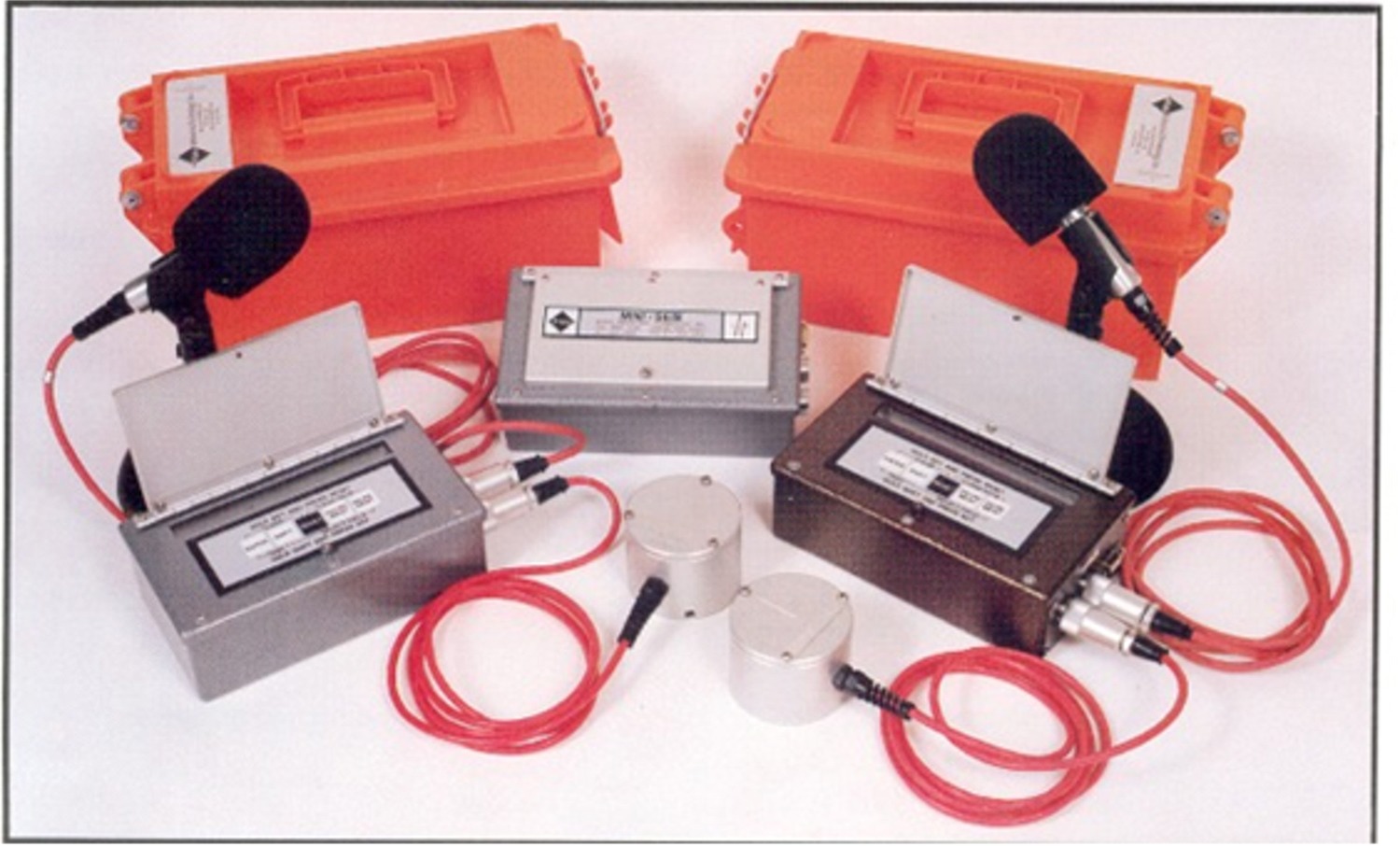
Mini-White Seismograph
Lightweight and easy to use. Includes convenient carrying case. Costs much less than comparable seismographs. Maintenance and calibration costs are also less. Rugged and shielded against RF interference. Keypad and display for easy field setup and data review. External seismic package and microphone interchangeable between units of like sensitivity.
Selectable seismic and acoustic recording range, seismic and acoustic trigger level, sample rate and record duration. Excellent power management. Rechargeable internal battery. Can use either AC or DC power for long term monitoring. Wave form (self-trigger and manual-trigger) and continuous bar graph (histogram) modes Sophisticated, non-loss data compression results in small record sizes and fast data transfer.
Communication with the Mini-Seis is also possible with landline, cellular or satellite modems. The data compression used by the Mini-Seis allows data to be downloaded several times faster than competing instruments. This feature saves time and reduces expense.
An external printer is available for those projects where on-site printing is needed. Each printer enabled Mini-Seis unit can have its own printer or one printer can be used with any number of units, and the instrument must have printer enabled firmware. For large monitoring jobs, the programming of multiple units can be accomplished quickly using custom designed software.

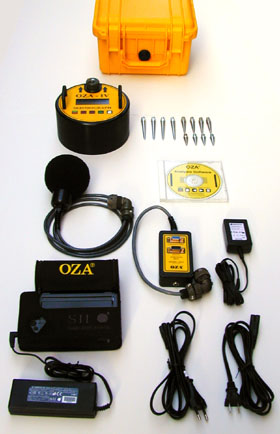
CVM-GPS Seismograph
CVM and GPS Seismographs come in a yellow box. They look identical to each other but are distinctly different. A CVM is equivalent to the bargraph mode of a White Seismograph. It measures vibrations. A GPS is equivalent to the waveshape mode of a White Seismograph. It measures frequencies.
How do I tell a CVM apart from a GPS?
Even though they look identical, there is a very easy way to tell the two apart. When turned on, a CVM will read “Ver 2.01”, compared to the GPS that will read “Ver 6.05”.
Connection Box: This is used for a number of reasons. It can be used to connect the units themselves to the computer to download events off off them. Also, it is used to connect the unit to the AC adaptor to charge the internal battery in the seismograph.
AC Adaptor: This is used for charging the unit. It is used along side the Connection Port.
Spikes: Spikes are also enclosed in the box. They are screwed into the GPS or CVM and used to couple the unit into the ground.
Microphone (MIC): This is connected to GPSs. They are used to measure acoustics. These microphones are interchangeable. They can be switched between different units.
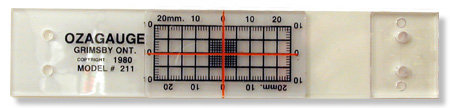
Oza Gauge
Developed in 1980, the OZA Gauge was designed out of necessity and demand. Its accuracy is guaranteed! Other companies have tried to copy it, but engineers, contractors, building inspectors, and homeowners keep coming back. The OZA Gauge is made of sturdy, lightweight LEXAN¨ - therefore, it's shrink resistant! Use the OZA Gauge for: Pre & post construction inspections with interior and exterior surveys of structures located near blasting, demolition and construction hazard assessment and monitoring. EASY TO USE: - accurate - inexpensive - interior-exterior cracks - Engineers - Contractors - Building Inspectors - Insurance Agents - Claims Investigators - Demolition Experts - Drilling & Blasting Crews
Determine where you wish to use the OZA Gauge -Remove the OZA Gauge from its packaging -Use a combination of Epoxy and screws to mount both sides of the OZA Gauge to the wall. -Ensure that the red crosshairs line up properly at center (0x, 0y axis). A small piece of tape has been applied to the top and bottom of the OZA Gauge to help keep the crosshairs aligned -OZA Gauge is mounted and tape is cut to allow both sides of the gauge to move freely -Monitor the OZA Gauge regularly. Determine a schedule and use the blank forms provided to record the results
| |